
October 27, 2026
10:00 - 11:30 AM Concurrent Sessions

Presenter:
Dr. Kris Barnekow
Session 1
A Sensory Health Approach to Attunement in Neurodiverse Dyads
Caregiver-infant attunement involves the sensory systems of two unique individuals. Human connection is a sensory experience, and all infants have adaptive mechanisms that contribute to this dance. What happens when one partner of the dyad is dancing the Polka and the other partner is expecting to do the Cha Cha Slide? Supporting dyads in finding their sensory rhythm can benefit neurodivergent caregivers and infants. During this presentation, participants will learn about building the capacity of caregivers to recognize the diversity of infant cues using a Sensory Health approach.
Learning Objectives:
Describe Sensory Health and how this approach can support caregiver-infant attunement.
Compare and contrast sensory integration and an intersensory perception model of early development.
Apply sensory integration and intersensory processing concepts to case presentations to formulate an action plan with caregivers and other infant mental health professionals.

Presenter: Anne Konen
Session 2
From Avoidance to Engagement: Navigating Tough Conversations with Skill and Self-Awareness
Difficult conversations are an inevitable part of relational work, yet many of us find ourselves avoiding, over-directing, or feeling overwhelmed when they come up. This interactive session is designed to support you in building the awareness, skills, and confidence needed to lean into challenging conversations with intention and care.
Participants will explore what happens internally when conversations feel hard, including nervous system responses, patterns of avoidance or control, and personal “warning signs” such as defensiveness or disconnection. The session will focus on self-awareness when you need to lean into a tough conversation, in addition to building capacity to support others as they facilitate them. Using a relational and reflective lens, we will examine how to stay present, grounded, and effective in the moment.
Together, we will identify the core components of a “good” difficult conversation such as safety, regulation, shared agreements, and active, generous listening and practice practical strategies to support these conditions. Participants will also reflect on their own strengths and growth edges and develop concrete action steps to apply in daily their work.
This session blends self-reflection, skill-building, and real-world application to help participants move from hesitation to intentional engagement in the conversations that matter most.
Learning Objectives:
Increase self-awareness through identification of their typical conversation patterns, recognize internal cues, and explore their own understanding of nervous system responses.
Develop practical skills to engage in and support challenging conversations with greater confidence, presence, and intentionality in daily work.
Identify opportunities to apply reflective and relational approaches within participants’ own professional settings including creating safety, practicing regulation, establishing shared agreements, and using active, generous listening.

Presenter: Martha Stolp

Presenter:
Lauren Gourley
Session 3
Reflective Practice & Consultation through the Confluence: Navigating the Journey as Parents & Helping Professionals
The confluence of identities as both parent and Infant Mental Health professional creates a profound and often unspoken shift — in our work and at home. Upon becoming parents, how we show up for clients, navigate countertransference, and understand ourselves as providers are forever changed, and painful dissonance can emerge when professional knowledge challenges our own parenting experience. This dual identity also holds significant potential: the reflective skills we cultivate can strengthen our capacity as parents, just as lived parenthood experience can deepen the authenticity and compassion we bring to our work. This session will examine salient themes and challenges alongside meaningful benefits of holding both identities, with particular attention to how reflective consultation supports reflective functioning personally and professionally. Participants will leave with reflective strategies to carry into professional practice, reflective supervision, and their lives.
Learning Objectives:
Identify seven salient themes and challenges related to the confluence of identity as parent and helping professional.
Describe six possible benefits of being both a perinatal provider and parent.
Utilize three reflective strategies to better explore and address the overlap of personal and professional identities in reflective consultation and supervision.
Presenter: Dr. Roxy Etta
Session 4
Kids & Screens: Supporting Families in a Digital World
Digital media is now deeply embedded in young children’s daily lives, shaping routines, relationships, and family interactions. Many families also feel overwhelmed by constantly changing technology, as well as uncertainty about how to navigate children’s screen use in healthy ways. As a result, conversations about media use can feel sensitive or overwhelming. This session focuses on how to engage families in supportive, nonjudgmental conversations about media use.
Participants will explore current recommendations for young children’s media use and key research on how digital media can influence children and family dynamics. The session also provides practical strategies for discussing these topics with caregivers, along with conversation guides and trusted resources to share with families.
Learning Objectives:
Describe current recommendations for young children’s media use.
Demonstrate supportive approaches for talking with families about media use.
Identify practical tips and trusted resources to share with families.
12:45 - 2:15 PM Concurrent Sessions

Presenter:
Abby Halloran

Presenter:
Kathleen N. Hipke
Session 5
The Art of Internal Process Fidelity in Child Parent Psychotherapy (CPP), Part I
*This advanced CPP workshop is for Mental Health Clinicians who have previously participated in the Child Parent Psychotherapy Learning Collaborative.
This workshop will introduce a new fidelity compass (2025) that has evolved to more fully capture and support practice of the evidence-based CPP treatment model. The workshop will then delve more deeply into Internal Process Fidelity, which focuses on how we foster embodied ownership of insight, internal shifts and external change in our work with families. We will consider approaches for inviting and honoring families’ felt experiences, observations and insights; promoting reflective capacity and connecting affect with experience. Balancing Internal Process Fidelity with well-timed developmental guidance and interpretation that artfully and skillfully works with unconscious processes and defenses will be considered and discussed. Clinical case vignettes and a more in-depth case presentation will be shared for illustration and application.
Presenter:
Samantha Wilson

Presenter: Sarah Strong
Presenter:
Briana Kurlinkus
Session 6
From Caregiver to Care Team: Building Supportive Networks Around Young Children
Children develop within the context of relationships, family, culture, and community—and every connection surrounding a child has the power to shape their emotional well-being and sense of belonging. This engaging session explores how families, educators, caregivers, and community supports can work together to create a connected circle of care around young children. Participants will reflect on the impact of culture and lived experiences on caregiving relationships, explore strategies for strengthening communication and collaboration, and learn how supportive adult partnerships foster resilience, identity, and healthy social-emotional development in young children.
Learning Objectives:
Recognize the importance of collaborative relationships between families, educators, and other caregivers in supporting infant and early childhood mental health and overall child well-being.
Identify barriers that impact communication, trust, and consistency across caregiving environments while exploring relationship-based strategies that promote emotional safety, co-regulation, and continuity of care.
Develop practical, culturally responsive approaches for building supportive caregiver networks that strengthen resilience, social-emotional development, and meaningful family partnerships.
Presenter:
Delechia Johnson
Presenter: Lisa Garlie
Session 7
The Pyramid Model is for Adults Too: Applying the Pyramid Model to Ourselves First, Part I
What if the strategies we use to support children’s social-emotional growth are exactly what adults need, too?
In this engaging, podcast-style, 2-part workshop, we flip the script on the Pyramid Model and turn the lens inward. Through storytelling, real-life scenarios, and reflective dialogue, we explore how the same foundational practices- building relationships, creating supportive environments, and responding to behavior with intention can transform the way we show up as educators, caregivers, and colleagues.
Imagine listening in on a dynamic conversation where humor meets honesty:
Why do we expect children to regulate emotions we haven’t learned to manage ourselves?
What does a “safe, predictable environment” look like for adults in the workplace?
And how can strengthening our own social and emotional skills ripple outward to the children we support?
Learning Objectives:
Apply practical strategies of the Pyramid Model to their own mindset and behavior
Gain tools for managing stress, emotions, and adult interactions more effectively
Discover a deeper understanding of how self-awareness impacts classroom and workplace climate
Renew energy and perspective for supporting others- by starting with themselves
This isn’t just another training- it’s a conversation. One that challenges, affirms and inspires you to grow from the inside out.

Presenter:
Marlow Fowlkes-Ware

Presenter:
Stephanie Kirklin
Session 8
Sleep, Attachment, and Regulation in the First Three Years: A Relationship-Based Approach for Early Childhood Professionals
Sleep is a foundational developmental process in early childhood, closely intertwined with emotional regulation, brain development, caregiver-child relationships, and family well-being. For infants and toddlers ages 3 months to 3 years, sleep challenges are common - and they often surface in the context of stress, trauma, developmental transitions, and caregiving dynamics encountered during home visits and early intervention work. This session will explore pediatric sleep through an infant mental health and relationship-based lens, emphasizing how sleep develops, why disruptions occur, and how caregivers' responses shape both sleep patterns and emotional security. Participants will examine common sleep concerns in the first three years, including night waking, sleep associations, separation distress, and caregiver exhaustion, while critically reflecting on how various sleep approaches may support - or strain - the caregiver-child bond.
Rather than prescribing one-size-fits-all solutions, this presentation will focus on helping professionals assess sleep within the broader context of attachment, regulation, culture, and family capacity, and to support caregivers in making developmentally appropriate and emotionally responsive choices. Practical strategies, language, and frameworks will be shared to help early childhood providers discuss sleep during home visits in ways that honor mental health, strengthen relationships, and reduce shame or polarization around "sleep training."
Learning Objectives:
Understand normative sleep development from 3 months to 3 years
Recognize the links between sleep, emotional regulation, and attachment
Support caregivers in addressing sleep challenges centered around caregiver and baby attachment
Navigate conversations about sleep with sensitivity to mental health, trauma history, and cultural values
2:30 - 4:00 PM Concurrent Sessions
Presenter:
Abby Halloran
Presenter:
Kathleen N. Hipke
Session 9
The Art of Internal Process Fidelity in Child Parent Psychotherapy (CPP), Part II
*This advanced CPP workshop is for Mental Health Clinicians who have previously participated in the Child Parent Psychotherapy Learning Collaborative.
This workshop will introduce a new fidelity compass (2025) that has evolved to more fully capture and support practice of the evidence-based CPP treatment model. The workshop will then delve more deeply into Internal Process Fidelity, which focuses on how we foster embodied ownership of insight, internal shifts and external change in our work with families. We will consider approaches for inviting and honoring families’ felt experiences, observations and insights; promoting reflective capacity and connecting affect with experience. Balancing Internal Process Fidelity with well-timed developmental guidance and interpretation that artfully and skillfully works with unconscious processes and defenses will be considered and discussed. Clinical case vignettes and a more in-depth case presentation will be shared for illustration and application.
Presenter:
Samantha Wilson
Presenter: Sarah Strong
Presenter:
Delechia Johnson
Presenter: Lisa Garlie
Session 10
The Pyramid Model is for Adults Too: Applying the Pyramid Model to Ourselves First, Part II
What if the strategies we use to support children’s social-emotional growth are exactly what adults need, too?
In this engaging, podcast-style, 2-part workshop, we flip the script on the Pyramid Model and turn the lens inward. Through storytelling, real-life scenarios, and reflective dialogue, we explore how the same foundational practices- building relationships, creating supportive environments, and responding to behavior with intention can transform the way we show up as educators, caregivers, and colleagues.
Imagine listening in on a dynamic conversation where humor meets honesty:
Why do we expect children to regulate emotions we haven’t learned to manage ourselves?
What does a “safe, predictable environment” look like for adults in the workplace?
And how can strengthening our own social and emotional skills ripple outward to the children we support?
Learning Objectives:
Apply practical strategies of the Pyramid Model to their own mindset and behavior
Gain tools for managing stress, emotions, and adult interactions more effectively
Discover a deeper understanding of how self-awareness impacts classroom and workplace climate
Renew energy and perspective for supporting others- by starting with themselves
This isn’t just another training- it’s a conversation. One that challenges, affirms and inspires you to grow from the inside out.
Presenter:
Marlow Fowlkes-Ware

Presenter:
Deborah O’Connor
Session 11
Starting Strong: Expanding IECMH Consultation to Perinatal and Early Childhood Health Settings
The effectiveness of Infant and Early Childhood Mental Health (IECMH) Consultation in early childhood education settings is well documented, but its potential reaches far beyond classrooms. IECMH Consultation uses a reflective, relationship-based approach to support providers who serve infants, young children, and their families. By helping professionals understand the social-emotional and mental health needs of young children—and strengthening their capacity to respond—consultation improves outcomes for both caregivers and children.
Our IECMH Consultation program, embedded within a statewide pediatric hospital system, has taken this proven model into new territory: perinatal and early childhood health settings. This expansion includes primary care clinics, prenatal and post-NICU clinics, and IECMH therapy programs, creating opportunities to support families during critical developmental windows. In primary care, consultants collaborate with providers during well-child visits, offering guidance on attachment, caregiver confidence, and developmental trajectories. In perinatal clinics, consultants work with expectant parents—many managing mental health diagnoses—to foster early bonding and prepare for the transition to parenthood. Direct interventions such as the Newborn Behavioral Observation (NBO) help caregivers interpret their baby’s cues, reinforcing their competence and connection.
Consultation also extends across hospital departments, including medical social work, complex care teams, and child life specialists. Topics range from sleep and challenging behaviors to trauma exposure and emerging mental health concerns, always framed through a lens of relational health. Adapting this reflective approach within a medical model has required creativity and collaboration, but the benefits are profound: providers report increased confidence in addressing emotional needs, and families experience stronger relationships and improved well-being.
Importantly, this work prioritizes equity and access, ensuring that families facing systemic barriers—such as poverty, mental health challenges, and limited healthcare resources—receive culturally responsive, relationship-centered support. By embedding IECMH principles in settings where families already seek care, we reduce stigma, increase reach, and promote early intervention for those who need it most.
This session will share lessons learned from implementing IECMH Consultation in healthcare settings, highlighting strategies for integration, common challenges, and the transformative impact on families and systems. Through interactive discussion and reflective practice, participants will explore how IECMH principles can be applied in diverse environments—starting strong by embedding mental health support from pregnancy onward. Attendees will leave inspired and equipped to bring IECMH Consultation into their own spaces, advancing a vision of comprehensive, equitable care for our youngest children and their caregivers.
Learning Objectives:
Participants will understand what infant and early childhood mental health consultation is, and the added value it brings to settings that serve young children and their families.
Participants will be able to identify some of the innumerable ways that infant and early childhood mental health consultation can be adapted across child-serving settings to uniquely support those environments.
Participants will have the opportunity to think critically about the benefit and the potential utilization of infant and early childhood mental health consultation in their own communities and work spaces.

Presenter:
Nicole Robinson

Presenter:
Golshan Motamedi
Session 12
Beyond the Bath Bomb: Why Understanding the History of Self-Care Changes How We Practice It
For Early Childhood professionals, the phrase "self-care" is often used to encourage sustained wellbeing and work. For many professionals though, the suggestion to "just practice self-care" can feel like one more task on the to-do list. Consequently, this well-intended suggestion has the potential to create feelings of guilt or shame and further exacerbate burnout. In Western society we often see the commercialization of self-care as a luxury which ultimately masks the complex systemic exhaustion that comes with caring for our youngest learners. However, when we reevaluate the modern "spa day" marketing, we find that the true history of self-care isn't about bath bombs or luxury at all; it is a radical tool for survival, born out of social justice movements.
This session invites early childhood professionals to reclaim self-care as a necessity for maintaining personal and professional wellbeing as well as ongoing efforts of advocacy. We will begin by exploring the term’s journey from labor rights to a medical concept, to a revolutionary and radical act of self-preservation. By understanding this history, we can shift our perspective from seeing self-care as an individualistic responsibility, to seeing it as a gateway that allows us to continually show up for the children and families we care for, allowing us to uphold best practices.
The second half of the presentation will incorporate practical psychoeducation specifically tailored for the ECE environment. We will explore tools and strategies to support professionals in the implementation of practices and to better understand the positive impacts of self-care on an individual, while also exploring beyond the individual model of wellness to explore community care and how educators can support one another to prevent collective burnout.
Learning Objectives:
Acquire historical Western context and education related to the evolution of “self-care”
Reevaluate the meaning and purpose of self-care
Establish practical skills and a sense of increased accessibility to engage in self-care practices daily
~ End of Tuesday Sessions. ~
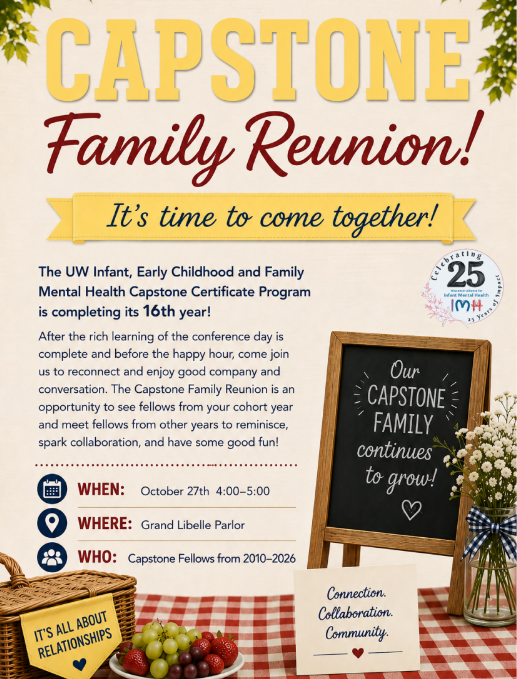
Capstone
“Family Reunion”
4:00 - 5:00 PM
Grand Libelle Parlor

5:00 - 6:00 PM
Happy Hour will include live music,
hors d'oeuvres, cash bar & connection!